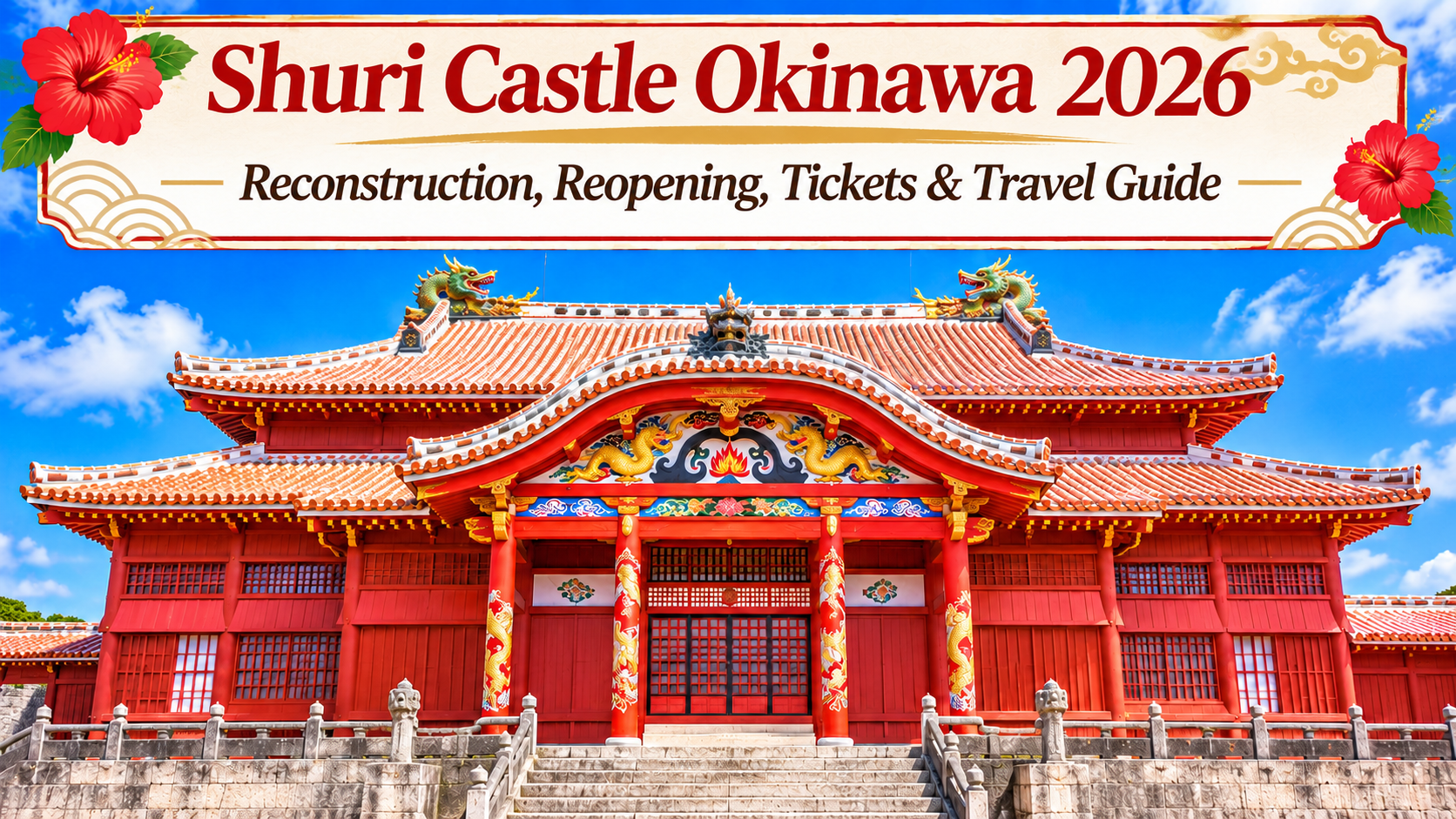
Looking for the best things to do in Okinawa in 2026?
Shuri Castle is one attraction you won’t want to miss.
Once the royal palace of the Ryukyu Kingdom, this famous castle is known for its stunning red architecture, beautiful stone walls, and unique history.
Following the tragic fire of 2019, the main hall has been carefully reconstructed and is scheduled to reopen on November 23, 2026.
In this guide, you’ll discover everything you need to know about visiting Shuri Castle, including reconstruction updates, ticket prices, advance reservations, opening hours, transportation, and the best attractions nearby.
Let’s explore one of Okinawa’s most remarkable historic landmarks.
Shuri Castle at a Glance
| Information | Details |
|---|---|
| Location | Naha, Okinawa, Japan |
| Famous for | Ryukyu Kingdom history and red palace architecture |
| Main hall reopening | November 23, 2026, at noon |
| Adult admission from Nov. 23 | ¥1,000 |
| Main hall interior | Timed reservation required |
| Nearest monorail station | Shuri Station |
| Recommended visit | 1.5–2 hours |
| Official website | Shuri Castle Park |
Shuri Castle Okinawa 2026: Reconstruction, Reopening, Tickets & Complete Travel Guide
Last updated: November 9, 2026
- 1. Discover Shuri Castle: Okinawa’s Historic Royal Palace
- 2. Shuri Castle Reconstruction 2026: From the 2019 Fire to Reopening
- 3. Shuri Castle Tickets, Reservations and Opening Hours
- 4. How to Get to Shuri Castle and Plan Your Visit
- 4.1 How to Get to Shuri Castle From Naha Airport
- 4.2 How to Get to Shuri Castle From Kokusai Street
- 4.3 Visiting Shuri Castle by Bus, Taxi or Rental Car
- 4.4 Shuri Castle Parking Map – Official and Nearby Parking Lots
- 4.5 How Much Time Should You Spend at Shuri Castle?
- 4.6 Shuri Castle Park Restroom Map & Facilities
- 4.6 Accessibility, Weather and What to Bring
- 5. Best Things to See at Shuri Castle and Nearby Attractions
1. Discover Shuri Castle: Okinawa’s Historic Royal Palace
1.1 What Is Shuri Castle, and Why Is It Famous?
Shuri Castle, also called Shurijo Castle, is a historic royal palace in Naha, Okinawa. For centuries, it served as the political and cultural center of the Ryukyu Kingdom.
Unlike many Japanese castles, Shuri Castle is known for its striking red buildings, curved roofs, and elaborate dragon decorations.
Its unique appearance reflects the history of Okinawa, which developed strong connections with China, Japan, Korea, and Southeast Asia.
The castle stands on a hill overlooking Naha, surrounded by impressive limestone walls and traditional gates.
Today, visitors come to admire its architecture, discover the history of the Ryukyu royal family, and enjoy the surrounding scenery.
The restored main hall has become an important symbol of Okinawa’s cultural heritage.
Even if you know very little about Japanese history, Shuri Castle offers an interesting introduction to the traditions that make Okinawa different from the rest of Japan.
1.2 The Fascinating History of the Ryukyu Kingdom
Before Okinawa became part of modern Japan, it was the center of the Ryukyu Kingdom.
The kingdom was established in 1429 and continued until 1879. During this period, its rulers governed the Ryukyu Islands and developed an important maritime trading network.
Shuri Castle was the home of the royal court and the center of government.
Merchants and diplomatic visitors traveled between Ryukyu and neighboring Asian countries, bringing new ideas, goods, and traditions.
These exchanges helped shape Okinawan music, food, clothing, and architecture.
In 1609, the Japanese Satsuma domain invaded the kingdom, bringing it under strong Japanese political influence.
The kingdom officially ended in 1879, when Japan established Okinawa Prefecture.
Understanding this history makes a visit to Shuri Castle especially rewarding. The palace is a reminder that Okinawa has a rich cultural identity shaped by centuries of international exchange.
1.3 Is Shuri Castle a UNESCO World Heritage Site?
Shuri Castle is connected to one of Okinawa’s most important UNESCO World Heritage properties.
In 2000, UNESCO added the Gusuku Sites and Related Properties of the Kingdom of Ryukyu to its World Heritage List.
This collection includes nine historic places across Okinawa.
However, there is an important difference between the historical castle site and the reconstructed palace.
The World Heritage designation applies to Shuri Castle’s archaeological remains and historic site, not to the modern rebuilt main hall itself.
The surviving foundations provide valuable information about how the castle developed over hundreds of years.
Some foundations belong to earlier periods, revealing that the palace was rebuilt several times.
For visitors, this makes Shuri Castle an unusual destination where archaeology and reconstructed architecture can be explored together.
It is a place to appreciate both the original history and the ongoing efforts to preserve it.
1.4 Why Does Shuri Castle Look Different From Other Japanese Castles?
If you have visited Osaka Castle or Himeji Castle, you may notice that Shuri Castle looks very different.
Many famous Japanese castles were designed with tall defensive towers and white exterior walls.
Shuri Castle developed as both a fortified royal residence and an important center for government and ceremonies.
The main hall features bright vermilion walls, decorative roof tiles, elaborate wooden pillars, and colorful carvings.
Chinese architectural influences are especially visible in the roof design and dragon decorations.
However, the castle is not simply a copy of Chinese palace architecture.
It combines foreign influences with traditional Ryukyuan building methods and materials.
Look carefully at the patterns and decorative details when you visit.
They reveal how the Ryukyu Kingdom created a distinctive architectural style through trade, diplomacy, and cultural exchange.
1.5 Why Shuri Castle Matters to the People of Okinawa
For Okinawan people, Shuri Castle represents far more than a historic tourist attraction.
It is an important symbol of the island’s history, cultural traditions, and identity.
The castle has survived repeated destruction and reconstruction.
During the Battle of Okinawa in 1945, the historic palace buildings were destroyed. The main hall was eventually rebuilt and opened in 1992.
In 2019, another fire devastated the reconstructed castle, deeply affecting communities throughout Okinawa.
The response was remarkable.
People across Japan and overseas donated money and supported the restoration effort. Craftspeople worked to recover traditional techniques and recreate the building’s historic appearance.
The rebuilding process has also helped younger generations learn more about Okinawan history.
When you visit Shuri Castle, you are not simply looking at a beautiful building.
You are seeing a place that continues to connect Okinawa’s past with its future.
2. Shuri Castle Reconstruction 2026: From the 2019 Fire to Reopening
2.1 What Happened to Shuri Castle in 2019?
On October 31, 2019, a major fire broke out at Shuri Castle during the early morning hours.
The flames spread rapidly through the wooden buildings.
Nine buildings were destroyed, including the famous Seiden main hall.
The fire continued for hours, leaving extensive damage and shocking people across Okinawa.
Images of the burning castle appeared in news reports worldwide.
The exact cause of the fire was not conclusively established. Investigators considered a possible electrical problem but could not confirm a definitive explanation.
Although the reconstructed wooden structures were destroyed, important archaeological remains and parts of the historic stone fortifications survived.
These remains helped guide the restoration project.
The disaster also encouraged major improvements to fire prevention systems.
Today, the castle’s reconstruction stands as an example of how communities can work together to protect a treasured cultural landmark.
2.2 How Long Did It Take to Rebuild Shuri Castle?
Reconstructing Shuri Castle has required years of planning, research, and highly skilled construction work.
The main hall restoration project officially began in November 2022.
Specialists studied historical documents, photographs, and construction records to recreate the appearance of the former royal palace.
The wooden structure gradually took shape, followed by roofing, decorative carvings, painting, and interior work.
In 2025, much of the restored exterior became visible.
By September 2026, the main hall restoration had reached completion, with final preparations continuing for its public opening.
Shuri Castle Reconstruction Timeline
| Year | What happened |
|---|---|
| 2019 | Fire destroys the main hall and other buildings |
| 2020–2021 | Recovery, research, and restoration planning |
| 2022 | Main hall reconstruction begins |
| 2023–2024 | Major wooden construction and roofing work |
| 2025 | Restored exterior becomes visible |
| September 2026 | Main hall restoration completed |
| November 22, 2026 | Official completion ceremony scheduled |
| November 23, 2026 | Main hall scheduled to reopen to visitors |
2.3 Traditional Craftsmanship Behind the Reconstructed Castle
One of the most interesting parts of the reconstruction is the amount of traditional craftsmanship involved.
Experienced carpenters, woodworkers, sculptors, and painters have contributed to restoring the main hall.
The project required careful recreation of wooden pillars, curved roofs, dragon carvings, and decorative patterns.
Traditional lacquer techniques were especially important in reproducing the building’s deep red appearance.
The reconstruction also incorporated materials connected with Okinawa’s history.
Fragments of roof tiles damaged in the 2019 fire were reused in materials for new tiles.
This gives the restored castle a connection to the building that existed before the disaster.
The project has also provided opportunities to preserve traditional skills and pass them on to younger craftspeople.
When visiting the reconstructed Seiden, take a moment to appreciate the small details.
They represent years of dedication and specialized knowledge.
2.4 How Has Fire Safety Improved?
After the devastating 2019 fire, preventing another disaster became one of the most important goals of the reconstruction.
Traditional wooden architecture requires special attention because fire can spread rapidly through timber structures.
The restored main hall includes improved fire prevention and emergency response systems.
New equipment includes electrical safety devices, automatic fire notification systems, and sprinklers.
These measures are intended to detect problems earlier and support a faster response if a fire occurs.
The restoration team also had to balance modern safety requirements with the historical appearance of the palace.
That is not always easy when working with traditional architecture.
Visitors may not notice every improvement because much of the equipment is carefully integrated into the building.
Nevertheless, these systems are an essential part of protecting Shuri Castle for future generations.
2.5 Is Shuri Castle Fully Reconstructed in 2026?
The answer is not completely.
The main hall, or Seiden, has been restored and is scheduled to reopen on November 23, 2026.
This is a major milestone for the castle and for Okinawa tourism.
However, the original royal complex contained several additional buildings.
The North Hall, South Hall, and other structures are expected to be reconstructed in later stages.
That means visitors should not expect the entire palace complex to look exactly as it did before the 2019 fire.
Some areas may continue to change as reconstruction work progresses.
The good news is that many historic gates, stone walls, viewing areas, and other attractions remain accessible.
Visitors can also learn about restoration techniques through exhibitions.
For the latest construction updates, check the official Shuri Castle restoration information.
3. Shuri Castle Tickets, Reservations and Opening Hours
3.1 When Does Shuri Castle Reopen in 2026?
The restored main hall of Shuri Castle is scheduled to open to the public on Monday, November 23, 2026, at 12:00 p.m.
The opening follows an official completion ceremony on November 22.
Visitors should pay attention to special arrangements during this period.
November 22, 2026: The entire castle park will be closed for the completion ceremony.
November 23, 2026: Free areas inside the castle walls are scheduled to open at 11:15 a.m., while the paid area and main hall will open at noon.
Regular visiting hours will apply afterward, unless the park announces additional changes.
The opening is expected to attract considerable interest from Okinawan residents and international visitors.
If you are planning to enter the main hall during the first few weeks, reserve your preferred date and time as early as possible.
3.2 Shuri Castle Admission Fees in 2026
Shuri Castle Park has free and paid areas.
You can enjoy several historic gates and outdoor areas without buying an admission ticket.
However, a ticket is necessary for the paid section, including access to the reconstructed main hall area.
Admission prices will change when the main hall opens on November 23, 2026.
New Individual Admission Fees — From November 23, 2026
| Visitor category | Admission |
|---|---|
| Adults | ¥1,000 |
| High school students | ¥760 |
| Elementary and junior high school students | ¥370 |
| Children under 6 | Free |
Groups of 20 or more may qualify for discounted admission.
The important point is that main hall interior viewing does not require an additional admission fee.
However, you must reserve a designated viewing time to enter the interior.
If you only want to explore the paid grounds and admire the outside of the main hall, an interior reservation is unnecessary.
For current prices, see the official ticket guide.
3.3 How to Book Shuri Castle Main Hall Tickets Online
Visitors who want to enter the restored Seiden must book a ticket with a designated date and time.
Reservations are offered through the official Webket ticketing system.
Start by opening the Shuri Castle English reservation page.
Choose the admission ticket that includes Seiden interior viewing, select your visit date, and pick an available time slot.
Complete the purchase and save the QR code issued with your ticket.
On the day of your visit, present the QR code at the Houshinmon ticket gate.
You will then proceed to the main hall according to your designated viewing time.
Reservation slots are organized in 30-minute intervals.
Allow plenty of time to reach the castle. The park recommends selecting a viewing slot approximately 40–50 minutes after your expected arrival at Shuri Monorail Station.
This helps avoid rushing through the gates.
3.4 Can You Visit Shuri Castle Without a Reservation?
Yes. You can still visit Shuri Castle without reserving the Seiden interior.
This is useful for travelers who prefer flexible sightseeing plans.
The park offers a paid-area admission ticket that does not include main hall interior viewing.
With this ticket, you can explore accessible sections of the grounds, admire the main hall exterior, visit exhibitions, and enjoy the observation areas.
You can also explore the free areas without paying admission.
If you decide that you want to enter the main hall, you must obtain a ticket with a valid viewing reservation.
Same-day reservations may be available if spaces remain, but there is no guarantee.
Visitors arriving during the busy reopening period should not rely on last-minute availability.
Even without an interior reservation, Shuri Castle remains an interesting destination for history lovers and photographers.
3.5 Shuri Castle Opening Hours and Special Closures
Shuri Castle’s opening hours depend on the season and whether you are entering a free or paid area.
The paid section opens slightly later and closes earlier than the free section.
Regular Opening Hours
| Area | April–November | December–March |
|---|---|---|
| Free area | 8:00 a.m.–7:30 p.m. | 8:00 a.m.–6:30 p.m. |
| Paid area | 8:30 a.m.–7:00 p.m. | 8:30 a.m.–6:00 p.m. |
| Last admission to paid area | 6:30 p.m. | 5:30 p.m. |
Remember that special arrangements apply on November 22–23, 2026.
Hours may also change because of special events, maintenance, or severe weather.
If your reservation is close to closing time, arrive early enough to pass through the admission gate and reach the main hall.
Check the official opening hours page shortly before your visit.
4. How to Get to Shuri Castle and Plan Your Visit
4.1 How to Get to Shuri Castle From Naha Airport
One of the easiest ways to reach Shuri Castle is by using the Okinawa Urban Monorail, commonly called the Yui Rail.
From Naha Airport Station, board a train heading toward Shuri and Tedako-Uranishi.
Get off at Shuri Station.
The journey from Naha Airport takes approximately 27 minutes, and the published adult fare is ¥360.
From Shuri Station, walk approximately 15 minutes to Shureimon Gate.
Reaching the main visitor facilities and paid area takes additional walking time.
The route includes some slopes, so comfortable shoes are recommended.
Alternatively, you can take a local bus from the station toward the castle area.
The monorail is especially convenient for travelers staying in central Naha because it avoids road traffic.
During the reopening period, public transportation is likely to be a more reliable option than driving.
4.2 How to Get to Shuri Castle From Kokusai Street
Kokusai Street is one of Naha’s most popular shopping and dining areas.
If your hotel is located nearby, visiting Shuri Castle is relatively straightforward.
The most convenient transportation option will depend on which part of the street you are staying near.
Travelers near Makishi Station can board the Yui Rail toward Shuri.
If you are staying closer to the western end of Kokusai Street, Kencho-mae Station may be more convenient.
Get off at Shuri Station and continue to the castle on foot or by local bus.
Taxis are another option, particularly if you are traveling with luggage or small children.
According to the official park guide, a taxi journey from Kokusai Street takes approximately 15–25 minutes, depending on traffic.
After exploring the castle, you can return to central Naha for shopping, dinner, or a walk through the Makishi area.
4.3 Visiting Shuri Castle by Bus, Taxi or Rental Car
Besides the monorail, Shuri Castle can be reached by local bus, taxi, or rental car.
Some bus routes stop very close to Shureimon Gate.
For example, Naha Bus routes 7 and 8 serve the Shurijo-mae stop, approximately one minute on foot from the gate.
Other bus routes stop at Shurijo Koen Iriguchi, about five minutes away.
Taxis are convenient if you prefer a direct journey, but travel times depend heavily on road conditions.
Rental cars are useful for exploring Okinawa beyond Naha, although driving is not always the best option for Shuri Castle itself.
Parking spaces at the park are limited and may fill quickly, especially during busy mornings.
If you are visiting around the November 2026 reopening, consider leaving your car at your accommodation and taking public transportation.
The official access guide provides detailed transportation information.
4.4 Shuri Castle Parking Map – Official and Nearby Parking Lots
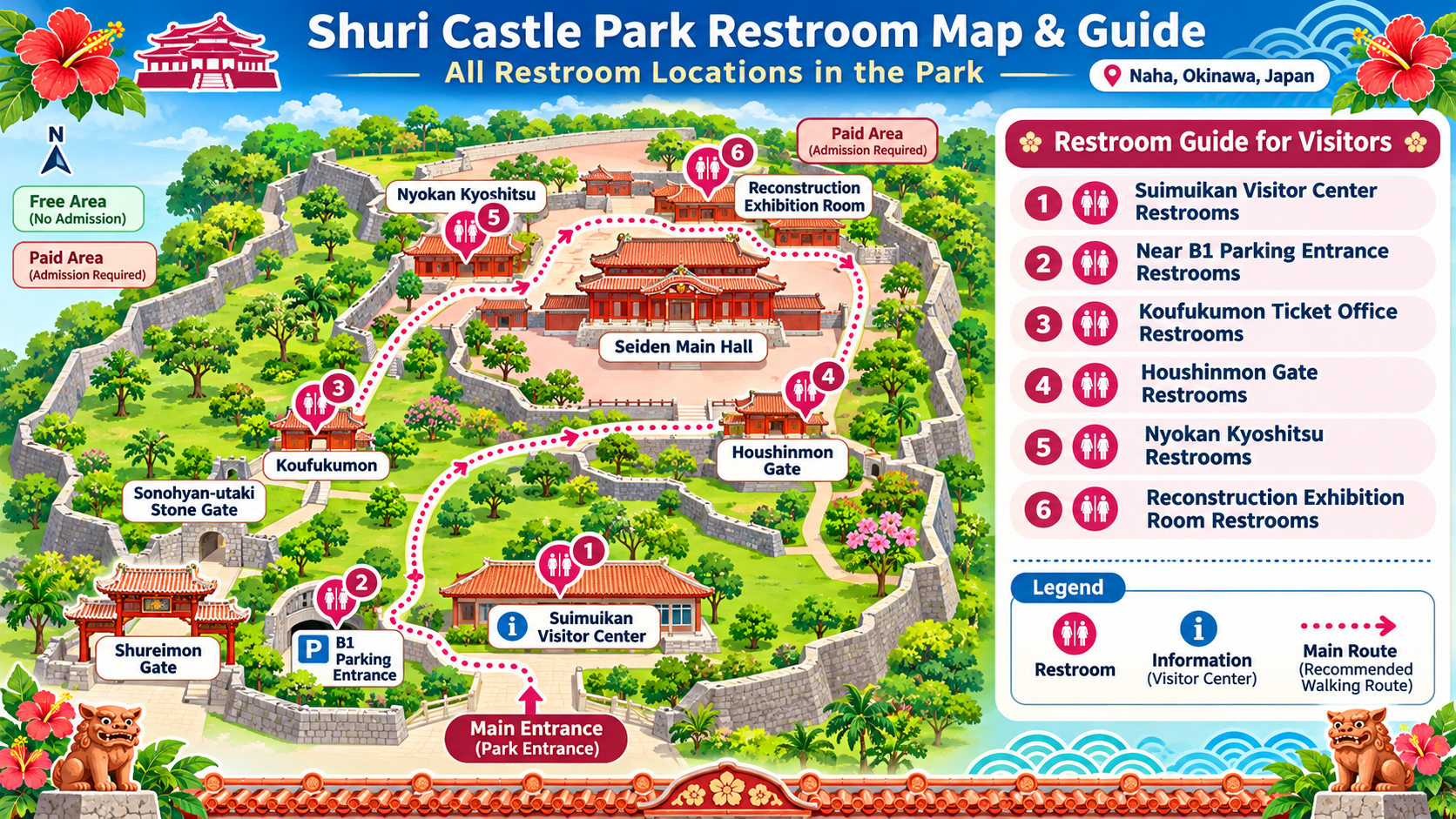
Planning to visit Shuri Castle by rental car? This parking guide shows the official underground parking facilities (P1 and P2) and several nearby paid parking options.
The official parking area is convenient for visitors exploring the castle. However, spaces are limited and may fill quickly on weekends, public holidays, and during the 2026 reopening period.
Travel Tip: Parking fees, availability, and operating hours may change. Always check the latest information before visiting.
Check Official Shuri Castle Parking Information
4.5 How Much Time Should You Spend at Shuri Castle?
For most first-time visitors, allowing 90–120 minutes is a good starting point.
This gives you time to walk through the historic gates, visit the paid area, admire the main hall, and enjoy some viewpoints.
If you have reserved Seiden interior viewing, allow extra time for walking and any queues.
The official park estimates approximately 15 minutes for the interior visit itself, although the complete route takes considerably longer.
Travelers who enjoy history and photography may prefer two to three hours.
If you are planning a full morning in Shuri, consider adding nearby historical sites after visiting the castle.
Do not schedule your main hall reservation too soon after arriving at the monorail station.
The castle grounds are extensive, and the route includes several gates and sloping paths.
A relaxed schedule will make the experience much more enjoyable.
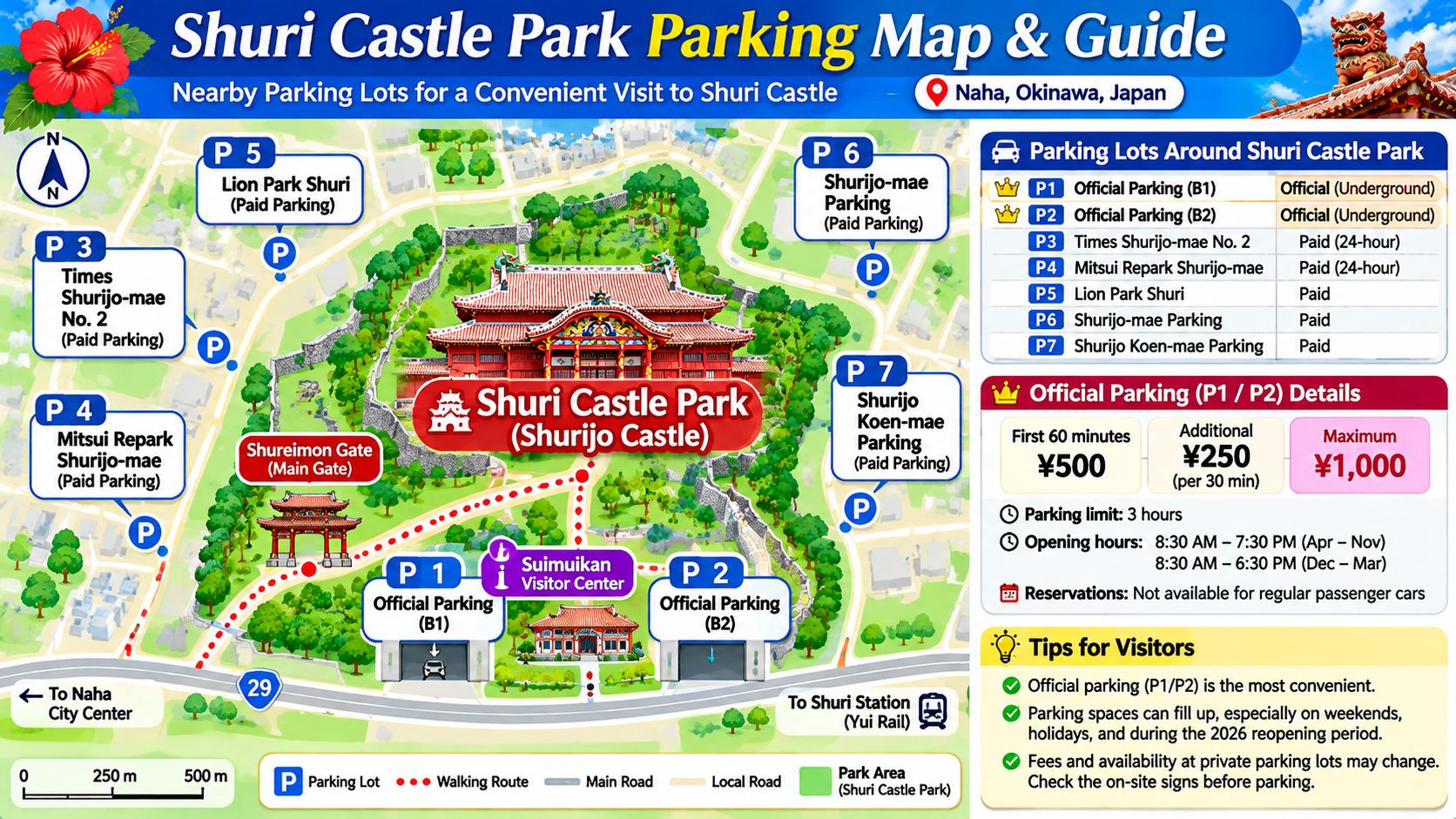
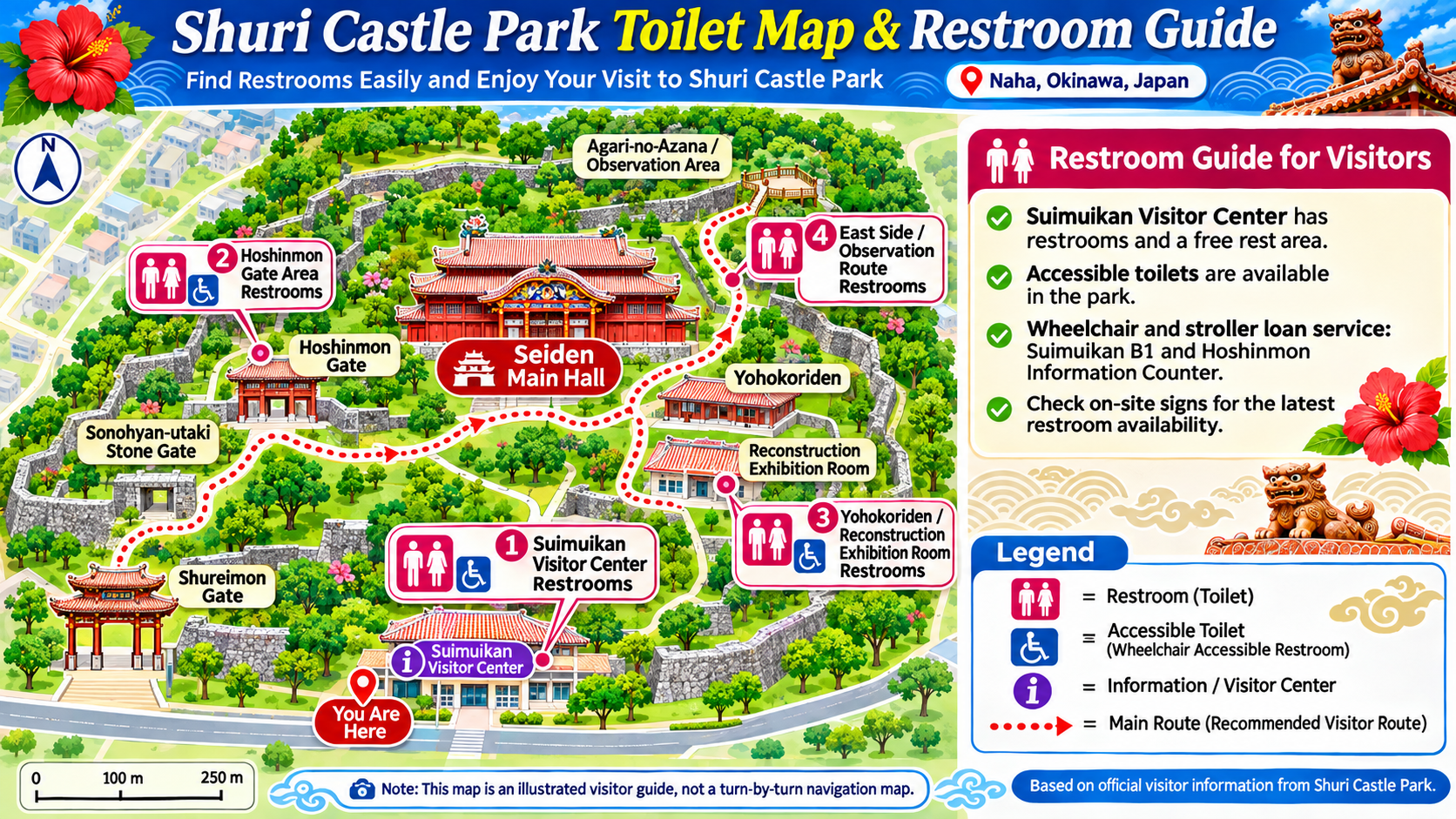
4.6 Shuri Castle Park Restroom Map & Facilities
Looking for restrooms while exploring Shuri Castle Park?
This illustrated restroom guide highlights key visitor facilities, including the Suimuikan Visitor Center and the castle’s main sightseeing areas.
The Suimuikan Visitor Center is a convenient place to use the restroom before exploring Shuri Castle. It also offers a free rest area and visitor information.
Accessible restrooms are available within the park, along with ramps and elevators to help visitors with limited mobility.
Travel Tip: If you’re visiting with children, elderly family members, or someone using a wheelchair, consider stopping at the Suimuikan Visitor Center before starting your sightseeing tour.
Please note that the illustrated map is not an exact navigation map. Restroom locations and accessibility may change during reconstruction work. Follow on-site signs or ask park staff for assistance.
For the latest information, visit the Official Shuri Castle Park Map and Accessibility Guide.
4.6 Accessibility, Weather and What to Bring
Shuri Castle is built on a hill, so visitors should expect slopes, stone pathways, and some stairs.
Lightweight clothing and comfortable walking shoes are useful throughout the year.
During summer, Okinawa can be very hot and humid.
Bring water, a hat, and sunscreen, especially if you plan to spend time outdoors.
Rain is another consideration. Some traditional stone surfaces can become slippery when wet.
For visitors who need assistance, Shuri Castle Park provides an accessible sightseeing route.
Wheelchairs, walking sticks, and strollers are available to borrow free of charge on a first-come, first-served basis.
The park also has ramps, elevators, and accessible restrooms.
If you have mobility concerns, visit the information counter at Suimuikan before exploring the grounds.
You can check the official accessibility information before traveling.
5. Best Things to See at Shuri Castle and Nearby Attractions
5.1 The Restored Seiden: Shuri Castle’s Main Attraction
The Seiden main hall is the highlight of Shuri Castle.
Its vivid red exterior, curved roof, decorative pillars, and dragon sculptures create one of Okinawa’s most recognizable views.
Historically, the Seiden played an important role in the royal government’s ceremonies and official activities.
The reconstructed hall allows visitors to imagine the appearance of the palace during the Ryukyu Kingdom period.
Look closely at the roof tiles and the detailed carvings around the entrance.
The colorful decorations reflect the artistic traditions of Okinawa and its historical connections with neighboring countries.
From November 23, 2026, visitors with a valid reservation will be able to explore the restored interior.
If you cannot obtain an interior reservation, you can still enjoy views of the outside from accessible areas of the paid grounds.
Either way, the Seiden is a remarkable example of Okinawan architecture and cultural preservation.
5.2 Shureimon Gate: One of Okinawa’s Most Famous Landmarks
Shureimon Gate is one of the most photographed places at Shuri Castle.
Its beautiful red pillars and distinctive roof make it an excellent introduction to traditional Ryukyuan architecture.
The gate is also famous for appearing on Japan’s 2,000-yen banknote.
Unlike the Seiden, Shureimon is located in an area visitors can explore without purchasing admission to the paid grounds.
This makes it a convenient stop even for travelers with limited time.
Another impressive entrance is Kankaimon Gate, historically used to welcome visitors to the royal castle.
Walking through these gates helps you understand how the palace complex was designed.
The gates, stone walls, and winding paths create a sense of moving through different layers of history.
Take your time rather than walking directly to the main hall.
Some of the castle’s most interesting architectural details can be found along the way.
5.3 The Observation Deck and Reconstruction Exhibitions
One of the most interesting ways to experience Shuri Castle is to view the restored Seiden from an elevated position.
The park developed an observation deck as part of its effort to share the reconstruction process with visitors.
From selected viewpoints, you can admire the main hall’s roof, decorations, and surrounding stone structures.
The paid area also includes exhibitions explaining the restoration project.
These displays help visitors understand how traditional materials and construction methods were used to rebuild the castle.
Look for information about wooden architecture, roof tiles, decorative painting, and fire prevention improvements.
Another worthwhile location is Agari-no-Azana, an elevated observation area offering views over Naha.
The scenery helps explain why the castle was built on this hill.
Because restoration work continues elsewhere in the complex, some routes or viewpoints may change.
Follow the park’s signs for the latest visitor route.
5.4 Tamaudun and the Shuri Kinjo-cho Stone-Paved Road
If you have more time, explore the historical neighborhood surrounding Shuri Castle.
One of the best nearby attractions is Tamaudun, a royal mausoleum built in 1501.
It contains the tombs of members of the Ryukyu royal family and is part of the UNESCO World Heritage property.
Its large stone walls and traditional tomb architecture provide another perspective on Okinawan history.
Another beautiful place is the Shuri Kinjo-cho Stone-Paved Road.
This traditional limestone pathway dates back to the Ryukyu Kingdom period.
A section of approximately 300 meters survives today, surrounded by old houses, greenery, and historic stone walls.
It is a wonderful place for a peaceful walk and photography.
Be careful when walking downhill, especially after rain, because the stones can become slippery.
Together, these attractions create an enjoyable half-day cultural experience in Shuri.
5.5 Is Shuri Castle Worth Visiting? Frequently Asked Questions
Is Shuri Castle worth visiting in 2026?
Yes. It offers an interesting combination of Ryukyuan history, beautiful architecture, and traditional culture. The reopening of the restored main hall makes 2026 especially significant.
Can I see Shuri Castle before November 23, 2026?
Yes. Accessible sections of the park remain open before the main hall’s reopening, apart from announced closure dates. The main hall interior is not yet open for regular visits.
Can I visit without a guided tour?
Yes. Independent visitors can explore the grounds using signs, maps, and visitor information.
Is Shuri Castle suitable for families?
Yes. Families can enjoy the open spaces and historical attractions. Some paths have slopes and steps, so plan breaks when traveling with young children.
What if I cannot book main hall interior tickets?
You can still visit the free areas or purchase admission to the paid area without interior viewing.
What is the best way to avoid crowds?
Check the park’s official crowd forecast and consider a less busy time slot. During the reopening period, flexibility is especially helpful.
Why Shuri Castle Belongs on Your Okinawa Itinerary
Shuri Castle is more than a beautiful historical attraction.
It tells the story of the Ryukyu Kingdom, Okinawa’s international connections, and the determination of local communities to preserve their heritage.
The restoration of the main hall following the devastating 2019 fire represents an important achievement.
With public access scheduled to begin on November 23, 2026, visitors will have a new opportunity to experience one of Okinawa’s most meaningful cultural landmarks.
For the best experience, remember three things: reserve in advance if you want to enter the main hall, allow enough time to explore the grounds, and consider visiting nearby historical places.
Whether this is your first trip to Okinawa or your fifth, Shuri Castle is well worth discovering.
Plan your visit: Official Shuri Castle Ticket and Reservation Guide
Official References
- Shuri Castle Park — Tickets and Reservations
- Shuri Castle Park — Admission Fees
- Shuri Castle Park — Opening Hours
- Shuri Castle Park — Access Information
- Shuri Castle — Reconstruction Progress
- UNESCO — Gusuku Sites and Related Properties of the Kingdom of Ryukyu
Information checked on November 9, 2026. Admission arrangements, opening hours, and access restrictions may change. Always consult the official website before visiting.